Opuntia ficus-indica
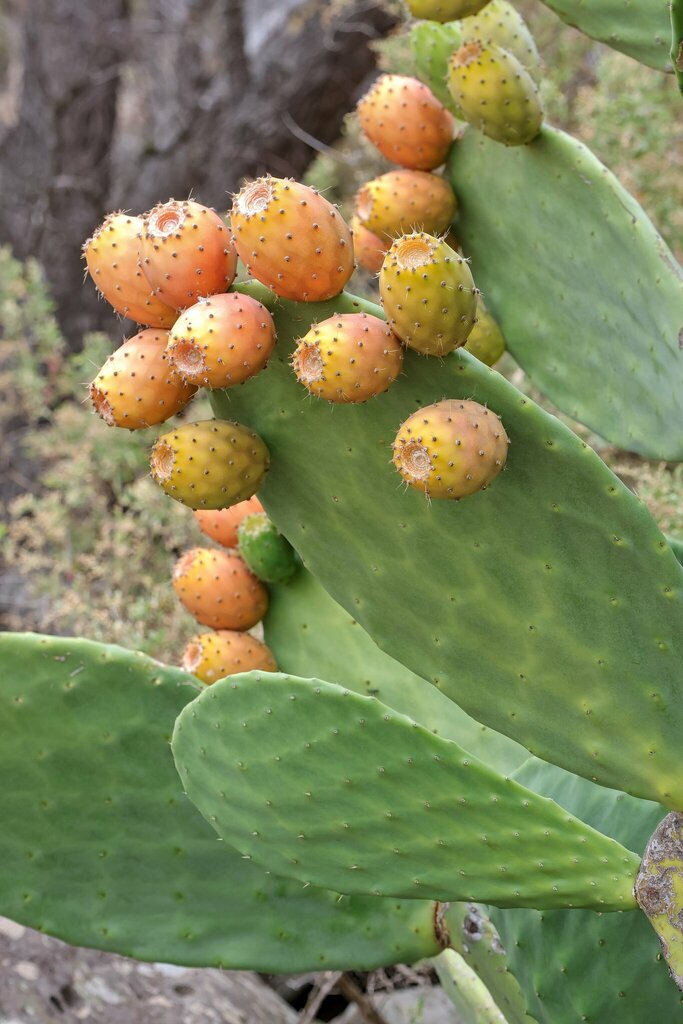
The size of the plant and of its bag can vary a little from the photograph — each one grows at its own pace. We keep them as consistent as we can.
Overview
Almost all of the nopal is eaten: the tuna fruit, sweet and gelatinous with something of a watermelon's freshness; the tender pads, cooked like green beans; and even the flowers. In Mexico the fruit is dried, pressed into queso de tuna, boiled into miel de tuna or fermented, and each preparation has a name of its own. It is a cactus of the kitchen, grown so long that nobody is certain where it came from — probably Mexico.
Culture
- Habit
- Evergreen Shrub
- Height
- 5.00 m
- Pollinators
- Bees, Insects
- Cultivation Status
- Cultivated, Ornamental, Wild
What decides this is not how much rain falls but where the water goes. The nopal does well in our rainfall; what it will not forgive is ground that pools or drains badly. Plant it in full sun somewhere the water leaves — a mound, a slope, sandy soil, a large pot with a coarse mix — and keep it out of the low spots where water sits. It prefers a high pH, 7 to 7.5, more alkaline than most of what we plant. Propagate by letting a pad dry for a few days before planting it, harvest from six to eight months, and a well-sited plant will last decades. Planting distance: 50 cm to 1 meter.
Edible Uses
The tuna fruit is eaten raw, cooked or dried: up to 10 cm long, 100 to 200 grams, and highly nutritious. The tender pads, nopales, are cooked as a vegetable and are somewhat mucilaginous; the flowers are eaten raw and the seed ground into meal. Mind the irritant hairs on both fruit and pad — rub or singe them off before peeling.
Medicinal
The flower is astringent and in folk tradition is used for intestinal complaints, with flower and stem used as an antispasmodic, diuretic and emollient. Warmed slices of the stem are laid on inflamed skin and joints to draw off heat, and a split pad has been bound around an injured limb as first aid.
_Traditional uses for information only. Not a substitute for advice from a health professional._
Traditional uses for information only. Not a substitute for advice from a health professional.
Agroforestry
It needs high light and establishes in the early secondary phase. What it contributes is not biomass but structure: the spiny forms make a fence livestock will not cross, and the shallow, wide-spreading root holds soil. Planted in a row along the contour, the nopal works as a physical obstacle to runoff — water slows, drops its sediment, and erosion stops working its way uphill. It is native to our region, which matters here: the advice to use it as a living fence applies inside its natural range, not outside it.