Pachira glabra
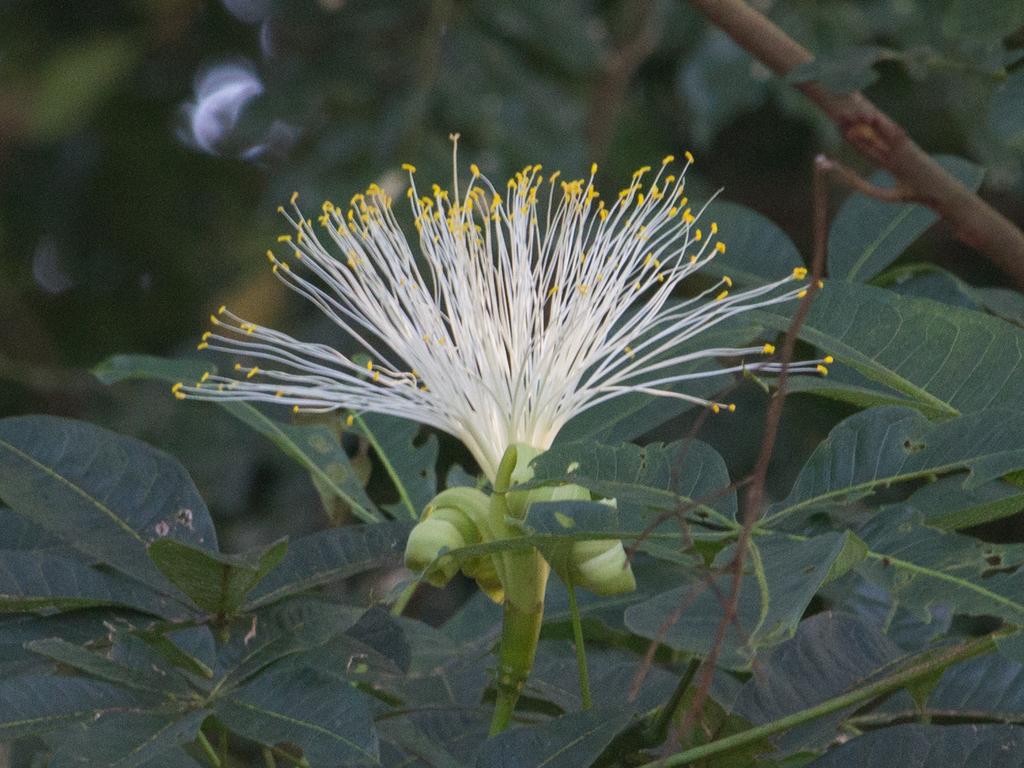
The size of the plant and of its bag can vary a little from the photograph — each one grows at its own pace. We keep them as consistent as we can.
Overview
The poponjoche's seed is eaten like a chestnut: roasted or boiled, rich in oil, tasting closer to a peanut than a nut. The tree comes from Brazil and is grown both for that seed and for its elegance — green-barked trunk, clean crown, unhurried habit — enough that there it gets planted in narrow streets. It grows fast: up to 3.5 meters in two years, and it lives a century.
Culture
- Habit
- Evergreen Tree
- Height
- 17.00 m
- Pollinators
- Insects
- Cultivation Status
- Cultivated, Ornamental, Wild
Plant it in deep, fertile loam, in full sun or light shade, 6–8 meters apart. At home it grows on alluvial plains and in lowland rainforest, mostly in secondary formations and at the foot of slopes; it is rare in closed primary forest. Give it the early years to form a trunk, and allow five to eight years to the first seed harvest. It also strikes from cuttings, which opens up uses beyond a standing tree.
Edible Uses
The seed is eaten raw or cooked, though the usual way is to boil or roast it like a chestnut. It is very rich in oil and its flavor is compared to groundnut. The young leaves are eaten too.
Medicinal
It has no recorded medicinal uses. Its relative Pachira aquatica, with which it is often confused, does — and what is said of the one does not hold for the other.
_Traditional uses for information only. Not a substitute for advice from a health professional._
Traditional uses for information only. Not a substitute for advice from a health professional.
Agroforestry
A high-light tree on a long secondary cycle — fifty to a hundred years — contributing food and structure to the system. Its best-documented agroforestry use is shading cacao: in Brazil it is planted in cacao groves for exactly that. Because it strikes from cuttings it is also used along the Brazilian coast for living fences, so the same tree serves as shade and as a boundary.