Tithonia diversifolia
The size of the plant and of its bag can vary a little from the photograph — each one grows at its own pace. We keep them as consistent as we can.
Overview
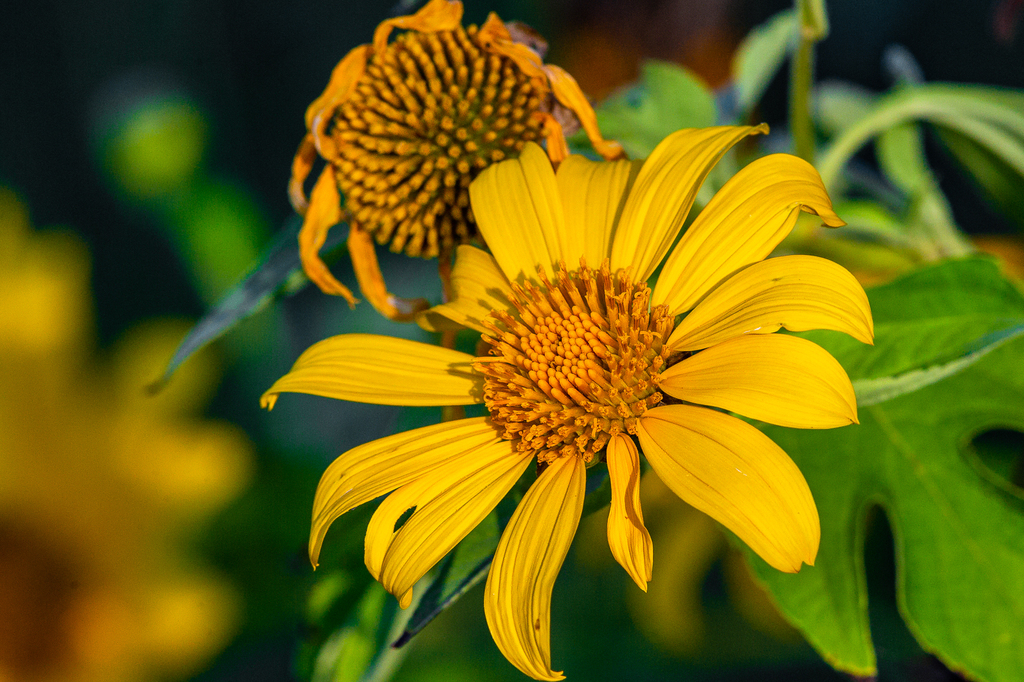
A biomass factory that also covers itself in yellow flowers. It grows at full speed and can be cut back again and again, with every cut feeding the soil, while bees and butterflies keep it busy. Its leaves are among the richest green manures there are: in trials, maize, kale, beans and tomatoes grown with tithonia gave bigger harvests. Native to our region, and one of the hardest-working plants in a syntropic system.
Culture
- Habit
- Annual/Perennial
- Height
- 3.00 m
- Pollinators
- Insects
- Cultivation Status
- Cultivated, Ornamental, Wild
Native to Central America, including Costa Rica, where it grows from the lowlands to over 2,000 m. It grows very fast in full sun, in almost any well-drained soil, and copes with dry spells. It readily roots from cuttings: a stem pushed straight into the ground takes within a few weeks. Cut spent flowers before they set seed if you don't want it to spread.
Edible Uses
Not edible. Its value is in the soil, not on the plate.
Medicinal
It has traditional uses against inflammation. Some studies also found toxic effects from concentrated extracts, so we don't recommend it as a home remedy.
Traditional uses for information only. Not a substitute for advice from a health professional.
Agroforestry
One of the great allies of a syntropic system: an early secondary species that produces large amounts of biomass, and with it protection for the soil. At Bodha Gardens we prune it every 3 to 6 months, depending on what the neighboring plants need and how old the system is. The cut stems and leaves stay on the ground as mulch and green manure. Its flowers draw pollinators, and it also works as a living fence. Plant 50 cm to 2 m apart.