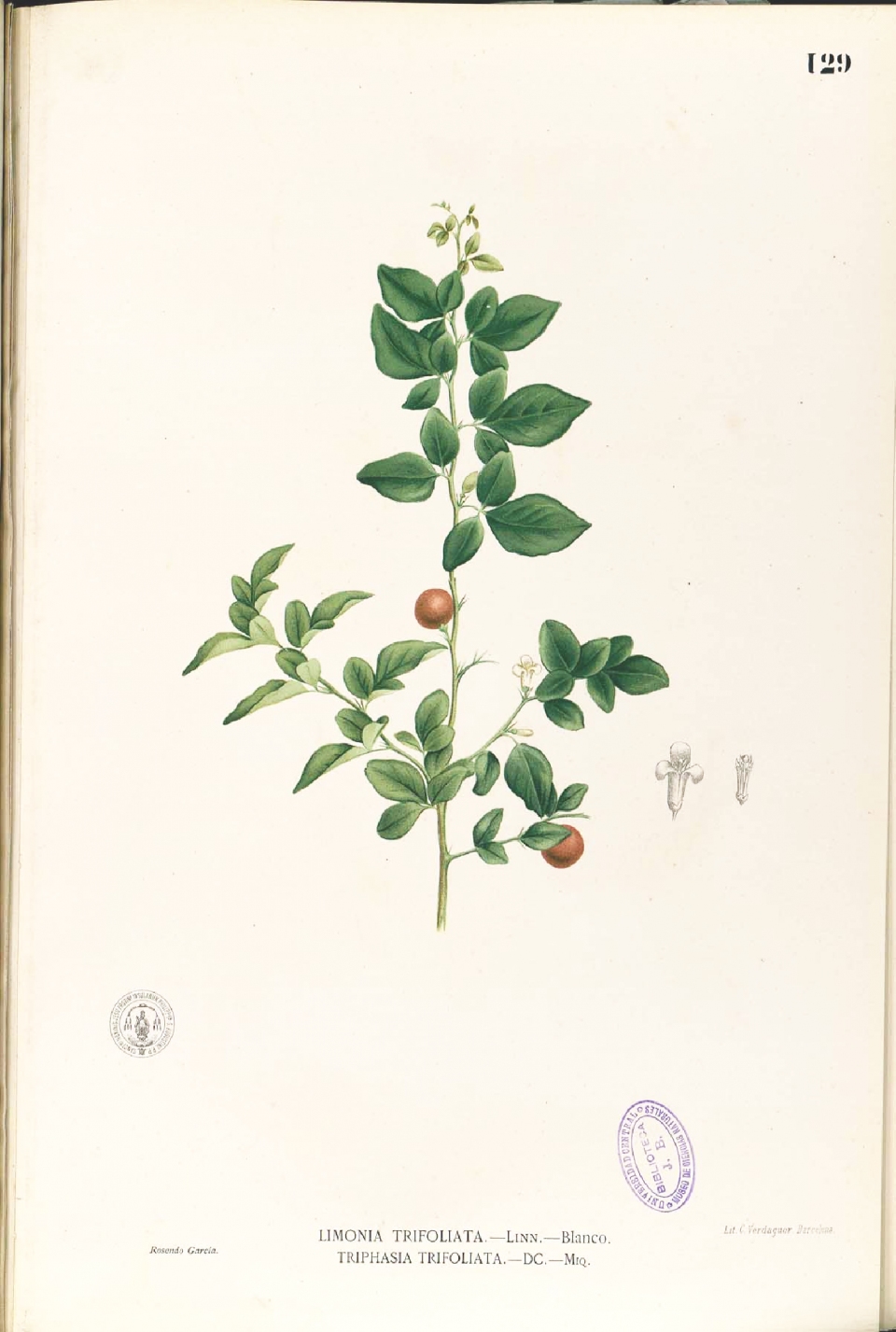
Triphasia trifolia
The size of the plant and of its bag can vary a little from the photograph — each one grows at its own pace. We keep them as consistent as we can.
Overview
Everything on this bush has a scent: the white flowers of orange blossom, the leaf of resin when you crush it, the ripe fruit of lemon. It's a shrub in the citrus family bearing red berries the size of a small grape, sweet and perfumed, and it flowers and fruits all year. Its thorns mean it, and that's its other job: a hedge nobody walks through, which also happens to be edible. It grows slowly, so it takes well to a pot and to bonsai.
Culture
- Habit
- Evergreen Shrub
- Height
- 3.00 m
- Growth Rate
- Slow
- Cultivation Status
- Cultivated, Ornamental, Wild
It wants full sun or partial shade and, above all, good drainage: it prefers loose, even stony soil, slightly acid, and will not forgive waterlogging. It grows slowly and stays between 1 and 3 meters, which makes it easy to keep in hand. Multiply it from fresh seed or from cuttings. For a hedge, plant 1–2 m apart and cut back the suckers from the base, since that is how it spreads.
Edible Uses
The red berries, about 15 mm across, are eaten raw when fully ripe: sweet and aromatic, with a mucilaginous undertone that makes one or two enough. Where they really shine is cooked, in jam and pickles, because the lemon perfume concentrates. The flowers are edible too.
Medicinal
In Southeast Asia the leaves are traditionally used for diarrhea and colic, and the fruit cooked with sugar for coughs.
Traditional uses for information only. Not a substitute for advice from a health professional.
Agroforestry
A food species of the medium stratum with a secondary life cycle, bearing from 3 or 4 years and living 10 to 20. Its natural place is the edge: a thorny living hedge that marks a boundary, keeps traffic out, and gives fruit at the same time. It spreads by suckers, so plant it where that advance is an advantage rather than a nuisance. Plant 1–2 m apart.