Xanthosoma sagittifolium 'Variegatum'
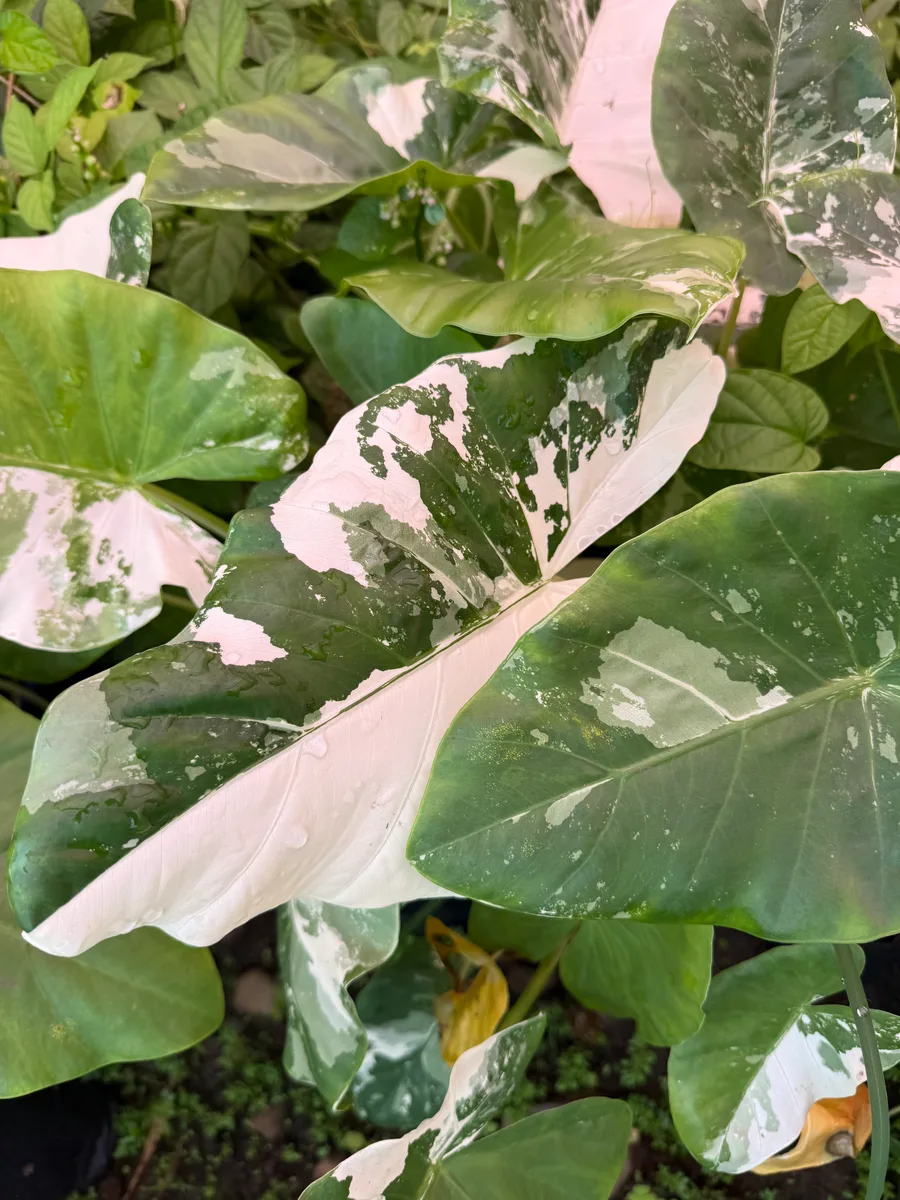
The size of the plant and of its bag can vary a little from the photograph — each one grows at its own pace. We keep them as consistent as we can.
Overview
Marquesa is the variegated form of white tannia (Xanthosoma sagittifolium), the same genus grown across Costa Rica for its edible corm — but this one is chosen for the leaf: big arrow-shaped blades splashed white and pale green, no two marked alike. It is an understory plant of tropical America, Costa Rica included, so in the garden it wants what it has in the forest: partial shade, warmth and humidity. Clumps reach 1.5–2 m and fill a shady corner quickly. It is propagated by dividing the offset corms rather than by seed, and each offset keeps the mother's variegation.
Culture
- Habit
- Perennial
- Height
- 2.00 m
- Cultivation Status
- Cultivated
Warm, humid lowlands below about 800 m, with rain spread through the year and humid air. Fertile, loose soil rich in organic matter, kept moist but never waterlogged. Half shade suits it best: strong sun scorches the white parts of the leaf, while deep shade dulls the variegation. Multiply it by separating offset corms from the clump, leaving roots on each. Plant 1–1.5 m apart.
Edible Uses
Across the genus, the corm and young leaves are eaten well cooked: tannia is everyday food in Costa Rica, boiled, fried or in soup, and the young leaves are cooked like spinach. Never raw — the whole plant carries calcium oxalate crystals that irritate the mouth and throat, and only thorough cooking breaks them down. The variegated form is grown for its leaf rather than its harvest, and yields less corm than field varieties.
Medicinal
We don't offer it as a medicinal plant. What is worth knowing is the opposite: the sap irritates skin, so wear gloves when dividing or pruning, and wash afterwards.
Traditional uses for information only. Not a substitute for advice from a health professional.
Agroforestry
A low-stratum plant for the shade cast by taller layers: it does well under fruit trees or along the humid edge of a system, covering ground with large leaves that shield the soil from hard rain and give biomass when cut. Because it multiplies by offsets, one clump fills the space without buying new plants.